
An AI agent acts on a wrong record just as readily as a right one, at machine speed.
Every agent you deploy reads from the same data layer, so the mistake doesn’t stay in one place. Confidently wrong, it routes a lead to the wrong owner, or books a meeting with the wrong company, before anyone notices.
A Data Agent is what’s built to fix that all-important layer first, before other agents can read it.
What’s a Data Agent in Salesforce?
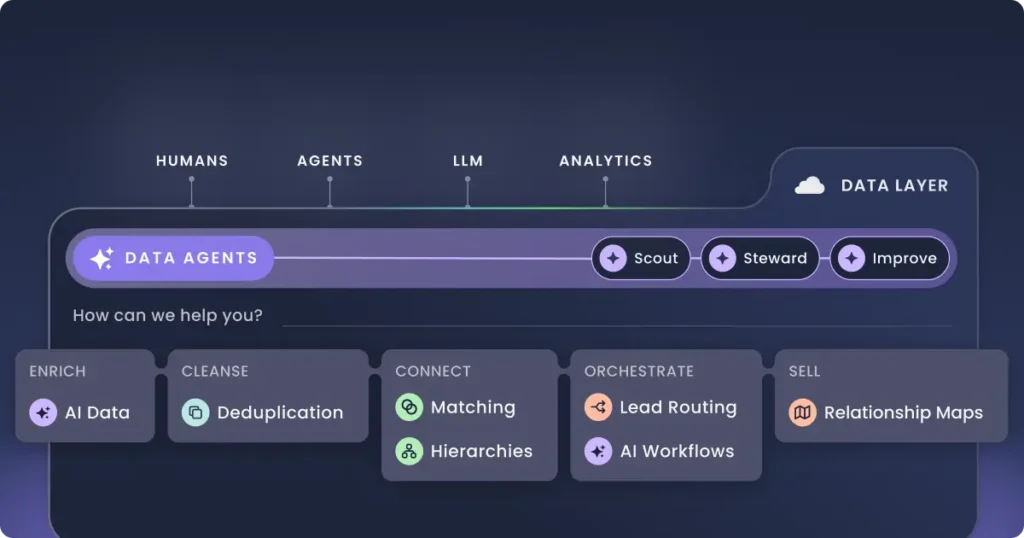
A Data Agent is an specialized AI agent that improves the data inside Salesforce. Data Agents operate within the Salesforce data layer, the records every agent, forecast, and routing rule reads before acting:
- Account records, contact records, and the relationships between them
- Opportunity records
- Account hierarchies (including parent, child, sibling, and ultimate)
- The buying committee on a deal
- The state of your lead-to-account matching
- Territory definitions
- Enrichment fields populated by third-party data providers
- Deduplication state (what is merged, what is queued, what is unresolved)
Data agents help build and maintain account hierarchies, match and clean duplicate records, fill missing fields, standardize formats, validate accuracy, classify accounts, and score what matters, so your tech stack, agents, and automations run on correct and complete information.
Data Agent vs. AI Agent
The analytics world uses “data agent” for an agent that queries a data warehouse and answers questions about it, the way Microsoft Fabric and Google Cloud use the term.
A Data Agent in Salesforce does the opposite job: instead of reading records and consuming the data layer, it improves the records.
That’s also what separates it from an enrichment tool.
Enrichment brings in new data from a data provider like Dun and Bradstreet (D&B). A Data Agent improves, connects, and governs the records already in the org. Traction Complete builds Data Agents inside Salesforce and groups the work into three motions: cleanse, connect, and orchestrate.
| Dimension | Enrichment tools | AI Agents | Data Agents |
|---|---|---|---|
| What it does | Adds new fields | Reads and acts on data | Fixes and improves data |
| Acts on | Missing fields | Your records, as-is | Records, under review |
| When it runs | On import or refresh | After the data is ready | First, on data before other agents read it |
| If the data is wrong | Overwrites it with vendor data | Acts on it at machine speed | Catches it before the write |
| Fails when | The vendor data is wrong | The input is wrong | Confidence is too low to approve |
| Without oversight | Overwrites good data, no flag | Acts on bad input, no flag | Waits for human approval before writing |
What Can Data Agents Do in Salesforce?
A Data Agent performs several distinct jobs on the data layer:
- Hierarchy Mapping builds corporate structure from ownership relationships, including augmenting account hierarchies with AI to catch the non-legal entities a provider does not track.
- Match Intelligence finds the records that represent the same company, the work underneath automated lead-to-account matching.
- Enrichment fills missing fields from the sources you already run, the way enriching accounts with sales intel does
- Normalization standardizes inconsistent values, from job titles and industry fields to phone numbers
- Validation checks accuracy before a write lands, which is the point of validating records on the way in
- Classification applies your own model, like assigning NAICS codes or modernizing industry classifications
- Detection watches the open web for change, such as M&A activity that should update an account
- Account Scoring ranks accounts for fit and survivorship so reps know which records to work and which one survives a merge
Data Agents and Stewardship
Few, if any, teams will let an agent write data unsupervised.
In fact, research from Harvard Business Review Analytic Services cites that only 6% of companies said they fully trust AI agents to run core processes without supervision. Gartner expects that more than 40% of agentic AI projects to be canceled by the end of 2027, and pins the cause on missing governance, not weak models.
AI doesn’t question your data. It acts on it.
David Nelson, CEO at Traction Complete
Every company we talk to is under pressure to deploy AI, and almost every one of them is aware that their CRM data isn’t ready.
Stewardship over your data is exactly what Data Agents provide. Every change it proposes arrives with evidence for you approve or deny it:
- Confidence score. Every change shows how sure the agent is before you act on it.
- Reasoning. The agent explains the logic behind each change it proposes.
- Source. Each value links back to where it came from, ready to verify.
- Approval gate. A human accepts or rejects the change before the write lands.
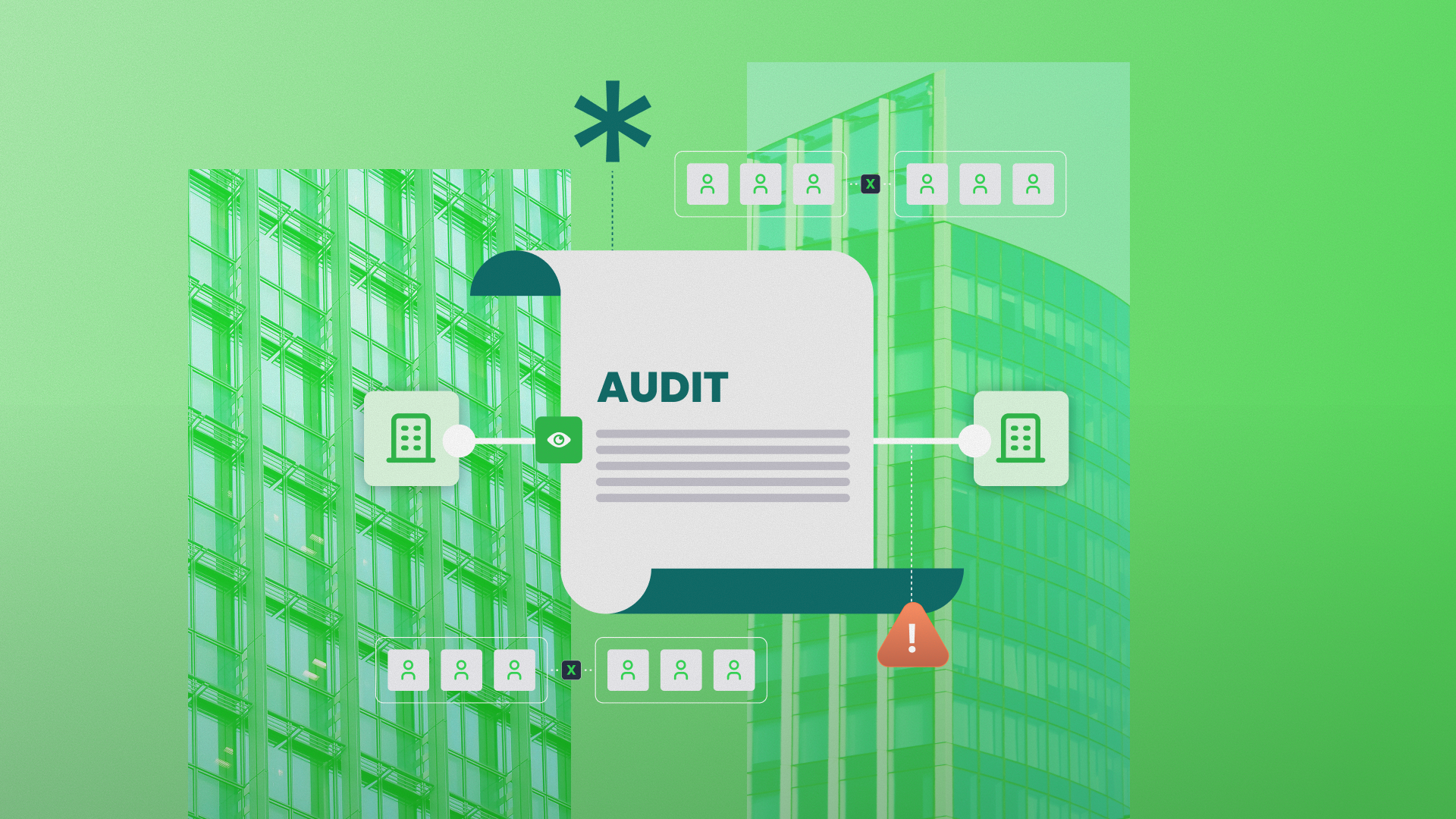
- Audit log. Every action is recorded and traceable after the fact.
- Learning loop. Each approval and refusal trains the next call.
Over time you can raise the confidence threshold where the agent has earned it, and keep a tight review where a wrong write costs the most. Just keep in mind that graduated trust among the data quality requirements for AI depends on the approval log more than on the confidence score.
Architect the Data Layer, Not Another Agent
A model is only as accurate as the records it reads. Upgrade the model and the wrong record is still wrong.
Every agent, forecast, and routing rule you run reads from the same layer of records, so that layer sets the ceiling on all of it. No model on top can be more right than the records underneath allow.
That puts the highest-return work upstream, in the records every agent inherits before it acts, not in the next agent you deploy.
Get the data layer right and the work itself changes shape. You stop auditing outputs and start trusting them, and the question moves from “is this number real” to “what do we do about it.”
None of this is new to the Revenue Architect. It’s the job they have always owned: deciding what the systems below the dashboards are allowed to treat as true.
Agents didn’t invent that work. They raised the stakes on doing it well, and made the cost of skipping it obvious.
Book a Data Agents demo to see how a record gets fixed before any agent writes to it.