
Businesses are past asking whether AI can do real work.
Revenue teams are already handing agents real operational tasks: prospecting, routing, and drafting customer answers. And Salesforce seems to be pushing the handoff the hardest. First with Agentforce and now with Claudeforce, its Anthropic partnership.
But the slick demos and flashy keynotes skip the prerequisite: the data fueling the AI.
RevOps teams at Fivetran, GitHub, and Inchcape Shipping Services have been dealing with both for a while. And their approach comes down to three key habits.
Salesforce Data Stewardship vs Data Governance
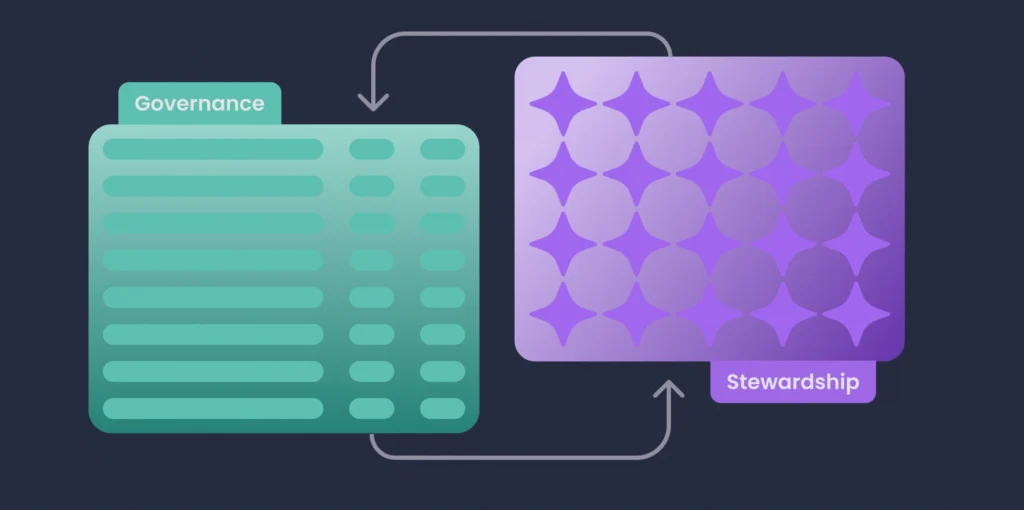
Stewardship and data governance often get conflated as one concept, but they’re two distinct jobs in Salesforce.
What is data governance?
Data governance is the set of rules deciding who may change which data and what a correct record has to contain.
In a Salesforce org, it looks like:
- Permission sets
- Validation and matching rules
- Restricted picklists
- Data dictionaries
What is data stewardship?
Data stewardship is the work of producing and maintaining correct records: merging the duplicates, setting the parent links, matching the leads to accounts, and correcting the field values.
Examples of data stewardship in Salesforce include:
- Choosing one Industry value for an account when the vendors you buy from disagree
- Deactivating an account for a company that was acquired last year
- Matching an inbound lead to the customer account it belongs to instead of creating a new one
Whereas data governance is dictating a validation rule requires an Industry value, executing that work is data stewardship. Both jobs sit inside RevOps data management, and neither replaces the other.
Why Salesforce Data Stewardship, and Why Now?
Data stewardship has always mattered, and putting it off has always been survivable, at the cost of time and wrong reporting months later.
But now, agentic workflows remove that delay, since what they read before acting is exactly what they act on.
Gartner calls it the context layer, a data element that curates and delivers the knowledge an unquestionably agent accepts to make a decision.
Salesforce is pushing agents hard. Agentforce and Data 360 revenue runs at nearly $3.9 billion a year, and Data 360 ingested 104 trillion records in one quarter. But they’re blunt around what happens if you don’t have the proper prerequisites:
Stand-alone agents without comprehensive customer context tend to fail.
Adam Alfano, Executive Vice President of Sales at Salesforce
To get accurate results, agents need the full picture. Otherwise, you get garbage outputs.
Beyond preventing “garbage” agentic outputs, there’s two more pressing reasons why Salesforce data stewardship is so crucial in the agentic era:
Your revenue context layer is a proprietary, competitive advantage
The GTM definitions your team sells against belong to you. Vendor’s opinions are inherently embedded in the data you purchase from them.
Industry values are a good example because they’re how vendors describe what that company does for the whole market, not what the company would purchase from you.
Take the financial services company Stripe, as an example.
If you ask three providers what industry it is in, it’s likely you’ll get three answers:
- Financial services
- Payments
- Data processing
None of the answers are particularly wrong, but only one value can sit in the Industry field. And that’s the value that drives your segmentation, territory assignment, and reporting.
From a buyer lens, Stripe is Financial Infrastructure.
A competitor lens? Fintech Infrastructure; a segment a rep can sell against.
An agentic workflow can start from your own definition of the Industry field instead of the vendor’s. And every decision downstream of that will run on that custom definition: segmentation, lead routing, and territories drafted around that custom taxonomy.
Those definitions form the proprietary part of the context layer, and third-party data can feed them or dictate them. If you’re going agentic to GTM faster and sell more effectively, why let third party data control how you sell?
Your historical data inherited every manual workaround
Stephen Daniels, Senior Director of Revenue Operations at Cresta, inherited a Salesforce org built by the reps who used it:
Before Traction Complete, we had no real way of identifying our territories or understanding our accounts.
Senior Director of Revenue Operations at Cresta
Our Salesforce was a makeshift amalgamation of different accounts being added by sales reps.
The problem was that Cresta sells to enterprises, and enterprises come with subsidiaries. A new lead could belong to a standalone company or to a customer the team already had, and the Parent Account field could not say which, so every lead required a manual check.
To sell effectively, reps manually filled the gaps.
And Cresta isn’t alone.
Salesforce’s 2026 State of Sales research, a double-anonymous survey of 4,050 sales professionals, found that 74% of them are focusing on data cleansing. That’s a lot of selling time spent on data.
In Cresta’s case, new accounts still arrived every week, with no link to a hierarchy or a territory. Some were standalone while others duplicated an account somebody had already created.
The consequence is familiar: leads reached the wrong owner, territories overlapped, and the team couldn’t measure its own coverage.
74% of Sales professionals could look at one of those leads and see a problem right away, but an agent has no such doubt.
Daniels puts a number to the cost:
There is a cost to bad data… if we didn’t have a solution like this in the first place to scale off, we would be building on a bad foundation that would cause hundreds of thousands of dollars of headaches in the future
Senior Director of Revenue Operations at Cresta
How 3 RevOps Teams Actually Run Salesforce Data Stewardship
When we asked RevOps teams in our guide to fixing the Salesforce data layer their biggest reason why it fails, nearly eight in ten named duplicates or a contested source of truth. Both are record-level problems.
| Top reason cited | Share |
|---|---|
| Data quality or duplicates | 46.9% |
| Source of truth, or conflicting systems | 31.3% |
| AI readiness, unsure which workflows to trust | 15.6% |
| Tool fatigue, too many disconnected systems | 6.3% |
Source: RevOps Coop x Traction Complete, 2026.
Data governance alone solves neither, and manual data stewardship isn’t feasible at this scale. Here’s how RevOps leaders actually run data stewardship in their orgs to execute agentic workflows to their fullest:
Implement an approve-before-write step
Three Revenue Architects walked us through their setups in the same guide, and all of them runs an approve-before-write step:
- Fivetran posts proposed changes to Slack for RevOps to approve
- GitHub stages AI-matched records for a human to confirm
- Inchcape Shipping Services treats it as non-negotiable on any field touching compensation
Ablla Strainer, Senior Director of Global Revenue Operations at Fivetran, rebuilt a data layer mid-merger and came away with one golden rule:
Don’t take off the training wheels.
Ablla Strainer, Senior Director of Global Revenue Operations at Fivetran
Jon-Sun Lu, Senior Director of Marketing Operations at GitHub, runs one to two million signups a month using a similar strategy:
We have AI that scans all the data and then stages it, and then put the human in the loop.
Jon-Sun Lu, Senior Director of Marketing Operations at GitHub
Radu Negru runs data at Inchcape Shipping Services, and he’s adamant about having a human behind the decision.
I’m the data governance guy. For me, human in the loop is mandatory and should never be taken off.
Radu Negru, Head of Data at Inchcape Shipping Services
Approve-before-write is the first play . But on its own it isn’t enough.
Tony Bader is a dental surgeon who researches AI-supported diagnostics at the American University of Beirut and advises ministries and NGOs on governance. Writing for the World Economic Forum, he calls the gap between the person who approves a decision and the system that shapes it the autonomy paradox.
Bader argues that the human-in-the-loop (HITL) approval step is paradoxical because it actually takes more human agency of out of the process than it puts in.
Under a typical HITL process, the agent has ranked the options, filtered the evidence, and picked a winner. The reviewer sees a narrowed set of options — usually one or two — and cannot see the alternatives. The decision left to the human is yes or no on a default, with “yes” being the faster answer.
Ultimately, the human holds the pyrrhic authority to choose but in reality, has lost most of the control over how the choice was formed in the first place.
Bader’s argument is that HITL becomes ceremonial when the reviewer only sees a choice dichotomy. His proposed fixes are to record what the system ranked and filtered, give the reviewer alternatives and evidence, and feed rejections back into the workflow as training.
Fivetran, GitHub and Inchcape already treat HITL as indispensable, and their setups cover Bader’s three fixes with two additions to the approval step.
Use confidence scores and audit logs to cut manual review time without losing the evidence trail
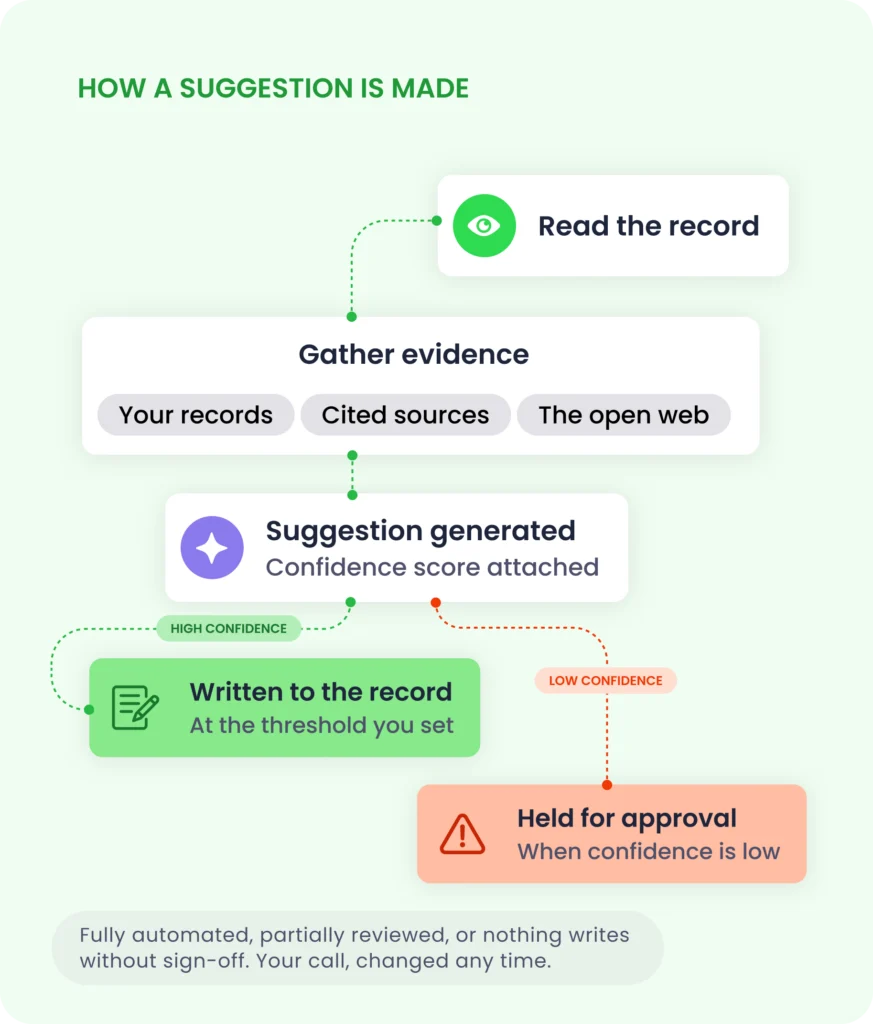
A confidence score tells you which suggestions need a second look, and an audit log records who approved what.
RevOps teams that are scaling revenue always ask for both before they let an agent write.
The immediate impression is that a confidence score only tells you whether a change is correct. But it also decides how many records you have to review.
High-confidence suggestions means you can clear them in batches with a quick spot-check. Low-confidence means making a judgement call. Having the freedom to set a confidence threshold lets you decide how much manual review you have to do and how long that’d take.
And if a change does turn out wrong, you’ll always have the audit log to default back to.
With critical fields and data points, if it affects compensation, company KPIs and the business, you need human in the loop.
Radu Negru, Head of Data at Inchcape Shipping Services
Radu starts with compensation, then the fields feeding company KPIs, then the rest. A field that reaches a rep’s commission statement stays at full review, and he keeps it there permanently.
Radu’s other rule covers the log. For him, treating data like a software asset means knowing what trained it, who owns it, and when it was last audited.
An audit log carries all three: the sources the agent read, the approver’s name, and the date it cleared. That’s why it’s a non-negotiable for Radu.
Set Stewardship Layer thresholds field by field and stop reviewing every change
The merging, the parent-linking, and the field-filling still have to happen.
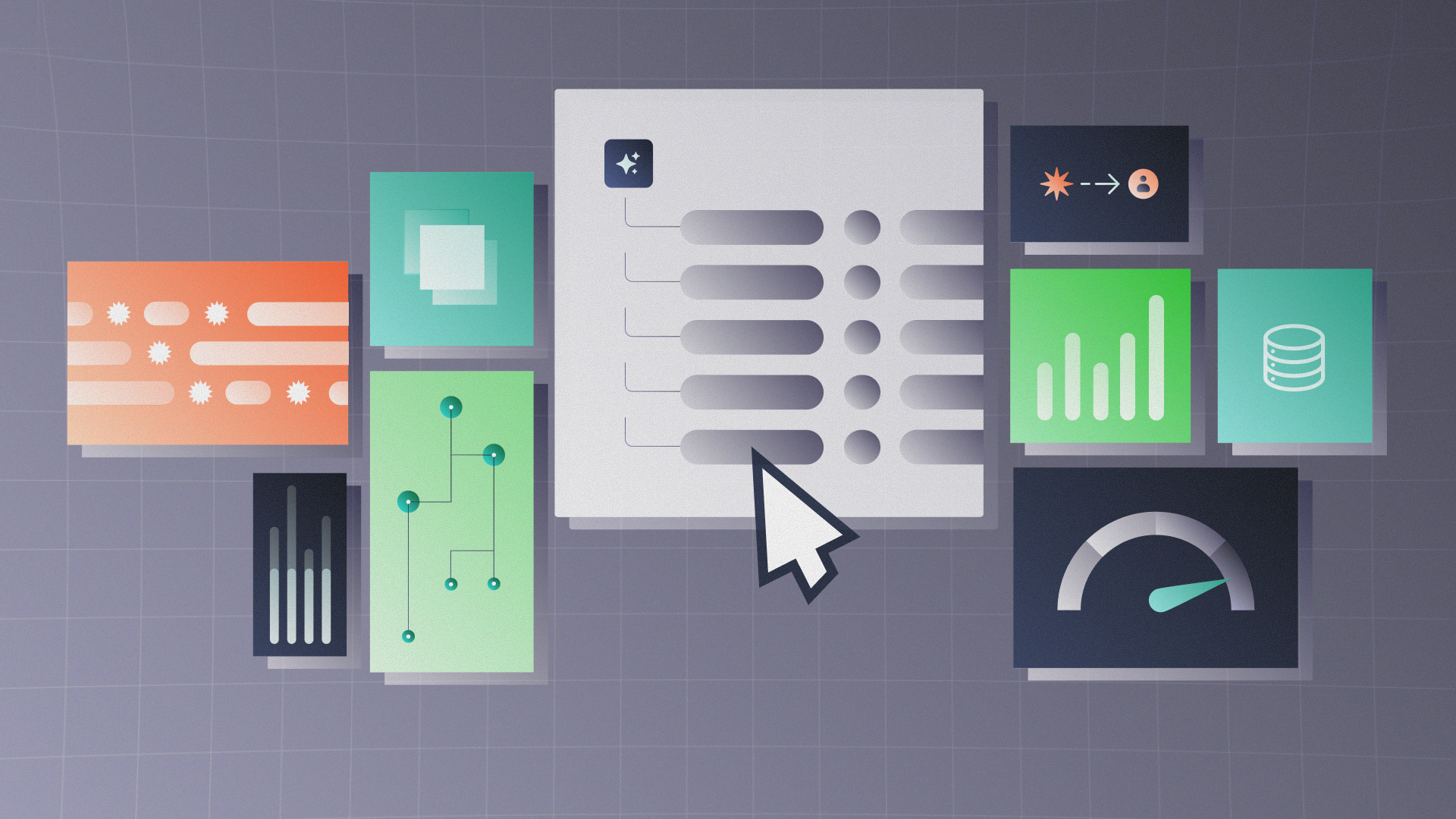
Data Agents, Traction Complete’s AI agents for the data layer, do that work inside Salesforce.
They’re 100% Salesforce-native, so the work happens where the records live. What data agents do reaches past merging and parent-linking into enrichment, normalization, and account scoring.
Sources follow a waterfall you configure. D&B and ZoomInfo slot in where you want them, and data agents fill what those sources leave empty.
Data Agents challenge filled fields, too. But only when agent-sourced data disagrees with the record and the data agent is confident enough in the replacement to propose a fix.
No data agent writes straight to a record: each one drafts its fix and queues it for your approval while showing its homework:
- A confidence score showing how sure the data agent is
- The reasoning and the sources it drew the change from
- An approval gate, where the change waits for your approval
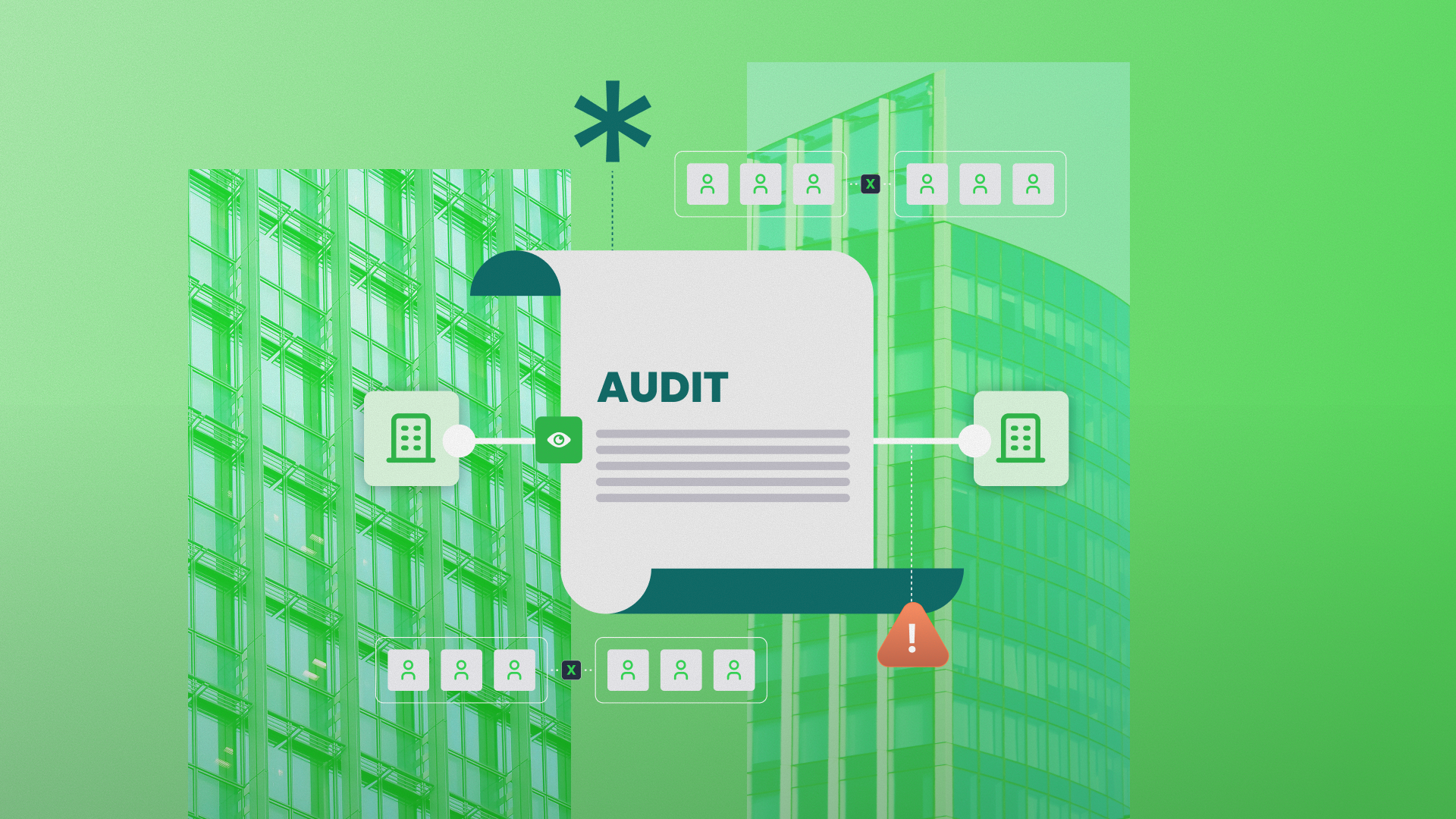
- An audit log, recording who approved what and when
Those four controls are the Stewardship Layer. Combined, they form your self-repairing data layer. Data agent finds the break, proposes the fix, and a named person approves it before your routing rules or a roll-up summary read the record.
The Stripe Industry field from earlier runs through it like this.
- Evaluate multiple inputs. Vendor values, what Stripe says about itself on its site and in its filings, and your written definition of each segment you sell into
- Use your own taxonomy. Data agents score each candidate against your definitions
- Review the work and sourcing. One value comes back, with its confidence, its reasoning, and the sources it read
- Choose when to automate. Above your confidence threshold for that field, the value writes
- Require human-in-the-loop for edge cases. Two candidates scoring close together send the record to a person, who sees the three vendor answers side by side
Every rejection is also training data. Each approval and refusal trains the next call, and the reviewer’s corrections become the agent’s definition of a correct value.
Over time, you can raise the confidence threshold where the data agent has earned it and maintain it where the override rate says the data is still wrong. This earned trust is one of the data quality requirements for AI outlined in our Dreamforce session with Chris Pickering, Manger of Sales Operations at Snap Inc., and the manual override rate is how you measure it.
Watch Ernesto Valdes and Chris Pickering walk through all ten requirements AI data quality requirements in the full Dreamforce session.
Put Salesforce Data Stewardship on Auto Pilot with Data Agents
Data Agents give you an agentic data governance system with executive stewardship power. The merging, parent-linking, and field-filling run at agent volume, with confidence scores and sources accompanying each proposed change, And your per-field threshold decides what writes through and what waits for a person.

Get Your Agentic Data Playbook
We wrote up the full set of plays that have the confidence scoring, sourcing, and the approval gating that RevOps teams at companies like Fivetran, GitHub, and Inchcape insist on. It’s called Crude to Revenue: 12 Agentic Data Plays for RevOps.
What’s inside:
- The four stages GTM data moves through between entry and revenue-ready
- 12 plays, each tied to a specific Salesforce object, field, or process
- Which plays to run first when your hierarchy and matching data are still unreliable
- A low-risk way to test agentic workflows with real records and no write-back