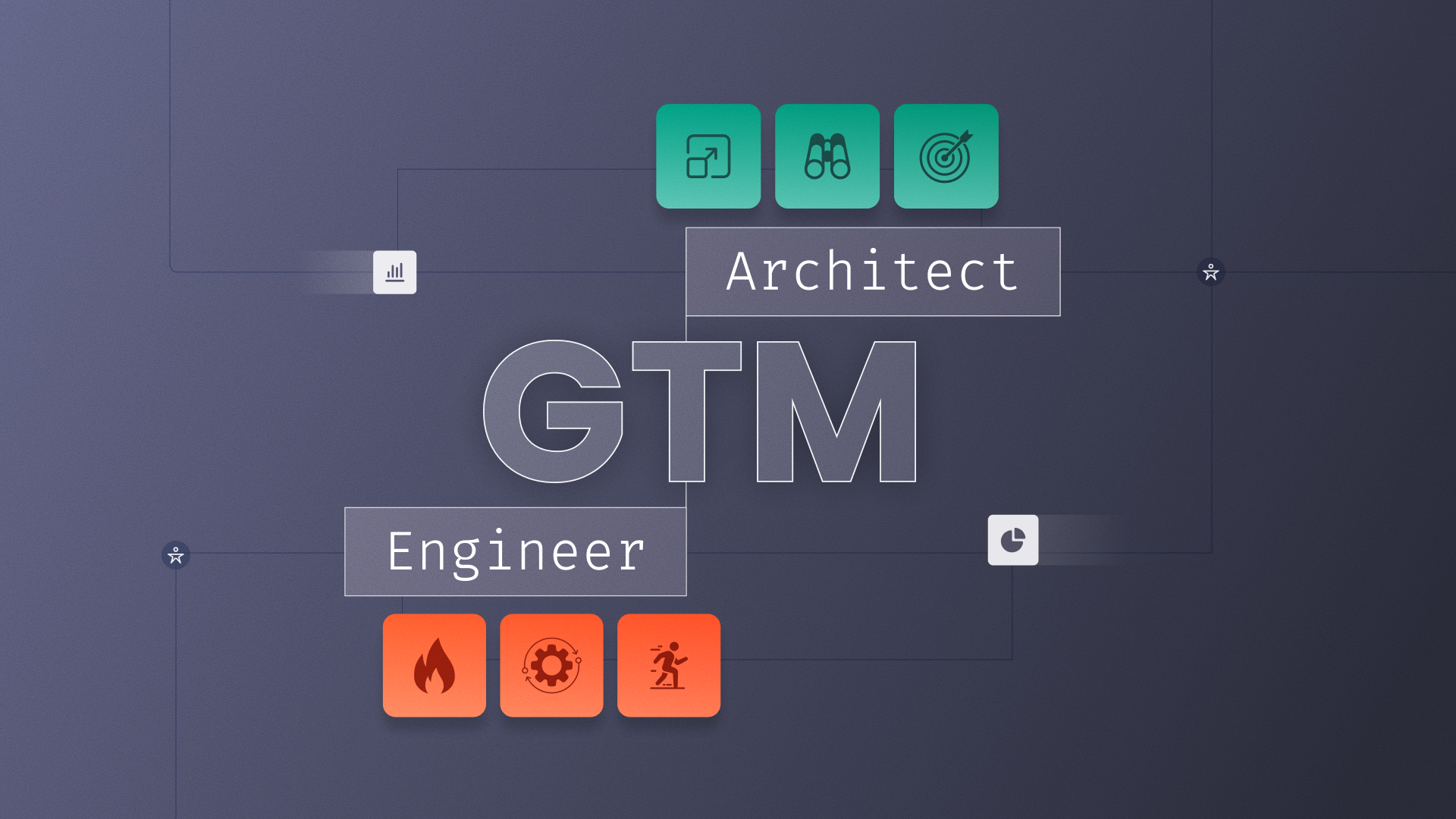

The GTM Engineer is the fastest-growing role in B2B revenue. Clay coined the term in 2023, and by January 2026, LinkedIn listed over 3,000 open positions with demand doubling in under a year.
And it’s no surprise why.
GTM Engineers build automated workflows that find, enrich, and activate buyer signals faster than any manual sales motion. The best ones generate pipeline that traditional outbound can’t touch.
But a GTM Engineer’s workflow is only as good as the data layer underneath it.
Bad account hierarchies, duplicate records, and broken routing rules make every automated play the GTM Engineer creates less accurate, less trustworthy, and harder to scale.
That gap is creating a new function: the GTM Architect or the Revenue Architect. It’s what RevOps becomes when AI absorbs the maintenance work and their strategic mandate finally returns home.
Whether you call it the GTM Architect or the Revenue Architect, the work is the same: design the system, hand the build to a GTM Engineer (or Revenue Engineer).
GTM Engineer vs GTM Architect
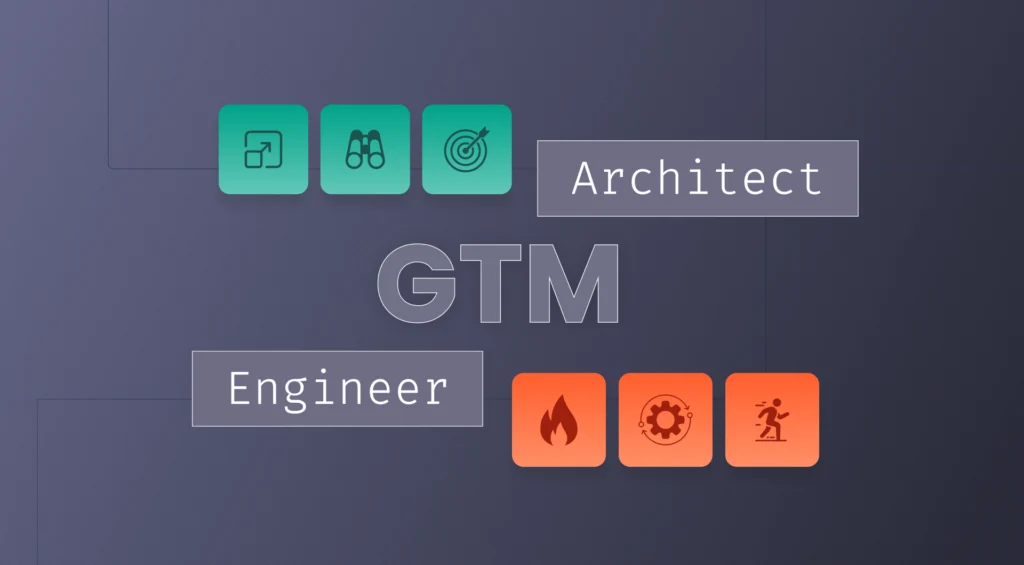
The GTM Engineer and the Revenue Architect operate at different layers of the revenue engine.
One builds the plays. The other builds the system those plays run on.
| Feature | GTM Engineer | GTM Architect |
|---|---|---|
| Role | Technical specialist who uses automation to capture revenue signals and convert them into pipeline. | Strategic leader who designs the data rules, governance, and workflows that allow those signals to scale. |
| Focus | Speed and execution. Finding the right moments to reach buyers based on behavior and intent. | Logic and scale. Building the rules for how signals get validated, enriched, routed, and acted on. |
| Key Activities |
|
|
| Main Deliverable | Automated workflows that turn a buyer signal into an immediate sales action. | The instruction set that governs how every signal moves through Salesforce: validated, matched, routed, and contextualized. |
| Business Value | Pipeline velocity. Surfacing opportunities that manual research would miss. | Compounding accuracy. A system that gets smarter and more precise with each layer the Architect adds. |
Moving from a System of Record to a System of Direction
Most CRMs (Salesforce included) run as a System of Record. They store what happened. Who called whom, which deals closed, what a contact’s title was six months ago.
Think of it as a paper map. Accurate when it was printed, but inaccurate by the time you unfold it.
Compared to a System of Record, a System of Direction is like a live GPS that directs the revenue engine to where to go next, using real-time data about the accounts, relationships, and signals around it.
When a new signal enters the system, the data layer knows what to do with it: validate it, match it to an existing account, resolve the ownership chain, and route it with context. No human intervention needed.
What breaks without a data layer?
Let’s say a GTM Engineer’s workflow identifies that a subsidiary of a target enterprise account just closed a $30M Series B. The GTM Engineer’s workflow creates a lead in Salesforce and triggers a personalized outbound sequence referencing the funding event.
But without a reliable data layer supporting that lead’s velocity, this is what happens:
- Native Salesforce account hierarchies don’t catch subsidiary relationships unless someone manually maps them, so Salesforce treats the subsidiary as an unrelated mid-market company.
- Round-robin assignment routes it to a mid-market SDR who has never spoken to anyone at the parent organization
- The enterprise AE who owns the parent account and has an open opportunity with the buying committee never gets notified
- The conflict comes up later when the prospect asks why two people from the same company are reaching out with no awareness of each other
The signal was right. The workflow was fast. But the revenue data layer underneath failed, and the GTM Engineer had no way to know.
That’s a System of Record working as designed: capturing the lead without directing it.
What happens with a System of Direction
Same trigger, funding round, and lead created in Salesforce.
But this time, we have revenue data layer in place. The Revenue Architect’s System of Direction:
- Automatically resolves the subsidiary to its global parent through automated hierarchy matching
- Identifies the AE who owns the parent account
- Checks for open opportunities on the parent and any sibling accounts in the hierarchy
- Routes the lead to the AE with full context attached
- Funding amount
- Subsidiary relationship
- Existing deal stage
- Intent signals that triggered the workflow.
The AE reaches out the same day. She references the existing relationship, mentions the funding round, and positions the conversation around expansion into the subsidiary.
It’s the same GTM Engineer working the same signals. But producing a completely different outcome. The difference is the instruction set underneath.
As Traction Complete CEO Dave Nelson puts it:
The future of revenue isn’t found in a database; it’s found in the compounding instruction set for growth.
Dave Nelson, CEO at Traction Complete
Why is the Revenue Data Layer Important, and Why Now?
For years, RevOps functioned as the plumber that kept data clean.
RevOps fixed broken data, reconnected integrations after they drifted apart, and deduped records after every list import or data migration. RevOps data management kept the CRM as accurate and accessible as possible.
But AI has changed that equation. The plumbing now runs itself:
With AI absorbing that maintenance layer, the Revenue Architect has time to write the rules that govern how the system behaves before those breaks happen.
Now, the Revenue Architect governs three things:
Data entry standards
- Signal validity. What counts as a real buying signal
- Field-level validation. Which fields must be verified before a record gets created
- Enrichment standards. What quality bar third-party data must clear before writing back
Without these rules, a GTM Engineer’s API-sourced enrichment creates inconsistent formatting, missing fields, and compounding duplicates across every integration.
Data routing logic
- Sequencing. Whether lead-to-account matching fires before or after enrichment
- Evaluation criteria. Whether routing reads territory ownership, hierarchy position, deal stage, or some combination
- Consistency at scale. Encoding these decisions in Salesforce so they execute identically at 10 leads per day and 10,000
These decisions used to live in a shared spreadsheet or in someone’s head. Now, they’re hardcoded into rules and automations.
Response rules
The Revenue Architect dictates how data should act when conditions change:
- M&A event. A parent account restructures. Do child territories update?
- Contact job change. A buyer moves companies. Does the lead recycle into the new account’s routing flow?
- Signal surges. A GTM Engineer’s workflow creates 200 leads from a funding trigger. Does the system validate, dedupe, match, and route all 200 without human triage?
GTM Revenue Orchestration: Why Order and Instructions Matter
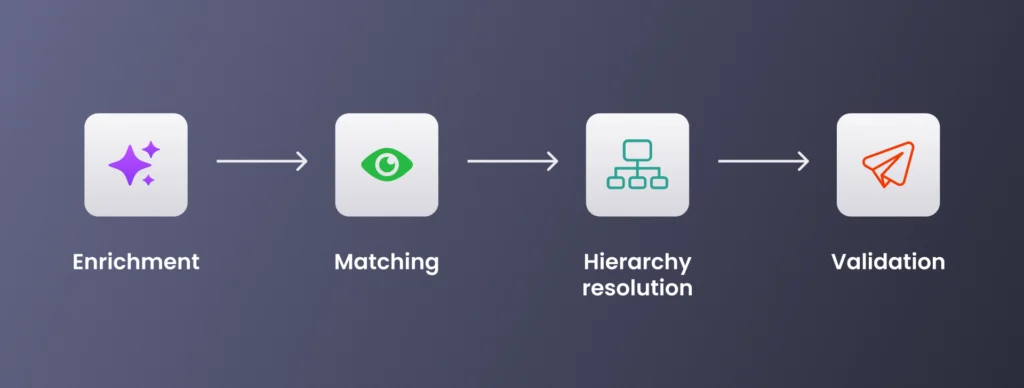
We’re not talking about BEDMAS, but the principle holds true: wrong order, wrong answer.
RevOps teams already have the tools: enrichment, matching, lead routing rules built for the age of AI. But the order this GTM infrastructure fires in decides whether they hand off clean data or pass errors downstream that the next layer can’t catch.
- Enrichment before matching. Running enrichment after a match decision doesn’t help because the match already happened on stale data.
But running enrichment first means the matcher has complete firmographics to work with: correct industry, accurate employee count, current tech stack. The match gets more accurate, and every downstream layer inherits that accuracy. - Matching before territory. If a lead matches an existing account, it should inherit that account’s ownership before territory rules evaluate geography.
Teams that route on territory first end up with leads landing on the AE whose patch matches the lead’s state instead of the AE who actually owns the parent account. - Hierarchy resolution before validation. Subsidiary accounts need to resolve to the parent before any downstream layer runs.
A US subsidiary of a Japanese parent shouldn’t validate the US subsidiary’s territory owner when the parent-level AE actually owns the relationship. - Owner validation before assignment. A matched account with an inactive owner is worse than an unmatched lead. Route to an inactive rep, and the lead sits untouched while your intent signal ages.
- Validation has to fire between hierarchy resolution and assignment. The lead’s prospective owner must be active, within capacity, and not on PTO.
One important caveat: a GTM Engineer working on top of this data layer won’t debug these problems.
It’s the Revenue Architect that handles these cases upstream. With the Revenue Architect’s System of Direction ensuring clean inputs, the GTM Engineer can focus on the signals themselves, and actually succeed.
AI Data Governance: Who Decides What AI Writes to Your CRM?
Every GTM Engineer’s workflow depends on some AI-sourced data. Clay, ZoomInfo, HubSpot, Agentforce,, custom APIs.
Each source is “mostly right” on its own.
What’s new is source conflict: multiple AI sources writing to the same Salesforce fields with brash confidence but less human oversight.
Picture this industry classification scenario:
- A GTM engineer workflow enriches a lead’s Industry field from LinkedIn and returns “SaaS” with 92% confidence.
- Thirty seconds later, a ZoomInfo sync returns “Computer Software” for the same field with 94% confidence.
Who owns the call?
If the GTM Engineer owns it, every approach has a failure mode:
- Highest confidence. Doesn’t work perfectly when both sources are above 90%.
- Last write wins. Routing will flip between the two enrichment sources every sync.
- Whoever built it owns it. The GTM Engineer doesn’t see what other workflows write to the same field, so ends up making siloed governance calls.
That’s why the call belongs to the Revenue Architect.
- The Architect sees the entire stack. Clay and ZoomInfo only sees its own enrichment, and the routing logic sees only the final field value. Only the Architect knows how each field feeds routing and everything else downstream.
- Architect-written rules outlast individual workflows. A precedence rule a Revenue Architect writes today still governs every new AI source the company adopts six months from now, even when the GTM Engineer’s specific workflow gets deprecated.
- System-level trade-offs need system-level authority. Choosing ZoomInfo over Clay for a field means accepting whatever ZoomInfo gets wrong about it.
Developing rules, order, and instructions
No one gets a prompt perfectly right on the first try, and production Salesforce isn’t the place to mess around with live data. The best Revenue Architects develop each rule in an AI data sandbox, like Complete Discover, first.
Complete Discover gives the Revenue Architect a place to draft the prompt, test it against real accounts, and watch the reasoning before a single record gets written to Salesforce.
The AI industry classification workflow:
- Import the conflicting accounts from Salesforce or CSV
- Pick your LLM (OpenAI, Anthropic, Perplexity, or Gemini)
- Write a prompt that scores each account through three strategic lenses instead of inheriting legacy NAICS classifications
- Run live scans against company websites, news, and financial filings
- Audit the reasoning column and confidence scores, then promote the validated prompt and output to production
Classification is the easiest conflict to picture, but it’s not the only rule the Revenue Architect develops this way. The same sandbox-first discipline applies whether the Revenue Architect is writing precedence rules, sequencing how layers fire, or shaping the broader instruction set.
Who’s Building Your Revenue Data Layer?
Every RevOps operator reading this has a choice. Claim the Revenue Architect mandate now, or watch it get reassigned to someone else in six months.
It’s already happening across the Salesforce ecosystem.
Admins are making data model calls, writing governance rules, and absorbing architectural work they were never hired or trained to do.
Salesforce Ben calls them “accidental architects.”
RevOps is heading into the same shift, and there’s no reason to be accidental about it.
If you’re claiming it, the first move is an inventory: which rules in your CRM are currently undocumented, owned by a Slack thread, or living in someone’s head? Each one is a future failure mode for an AI workflow you haven’t built yet.

Meet Three Revenue Architects Already Doing the Job
Our guide to fixing the data layer follows three working Revenue Architects: Fivetran’s Senior Director of Global Revenue Operations, GitHub’s Senior Director of Marketing Operations, and Inchcape’s Head of Data.
Their playbooks cover the instruction-set work: consolidating accounts through M&A, governing master data under outside scrutiny, and standardizing high-volume funnel data. And includes the five plays every Revenue Architect came back to.