
Agents built to fix the data itself.
Built for RevOps, Sales Ops, and Salesforce admin teams: the people who own data quality at scale.
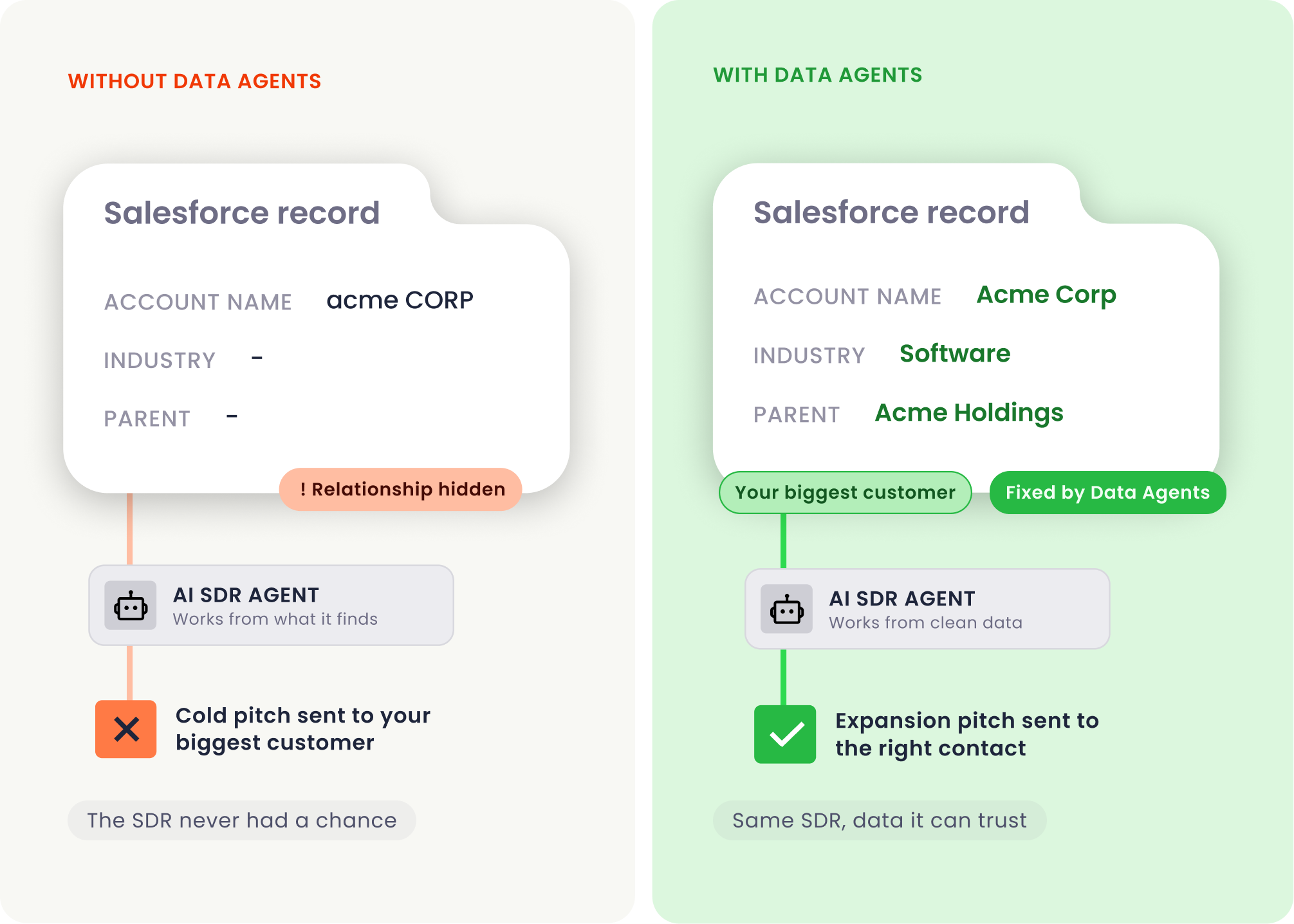
Keeping CRM data accurate still comes down to provider feeds, spreadsheets, and manual cleanup. Data Agents change that:
Agents consume.
Data Agents improve.
Other agents inherit your data problems. Ours solve them. Data Agents go into the record itself, fix what’s broken, and make the data worth trusting before anything else acts on it. This is the data layer your whole go-to-market stack sits on.
They work where your data lives
Inside your org, on the same records your team uses every day.
They shape data to how you sell
Most data is one-size-fits-all, and teams bend the business to fit it. Data Agents work the other way around: every record classified, segmented, and structured your way.
They lift everything downstream
Routing, scoring, reporting, and every other agent you run all read from data that’s right.
Your sources, your call.
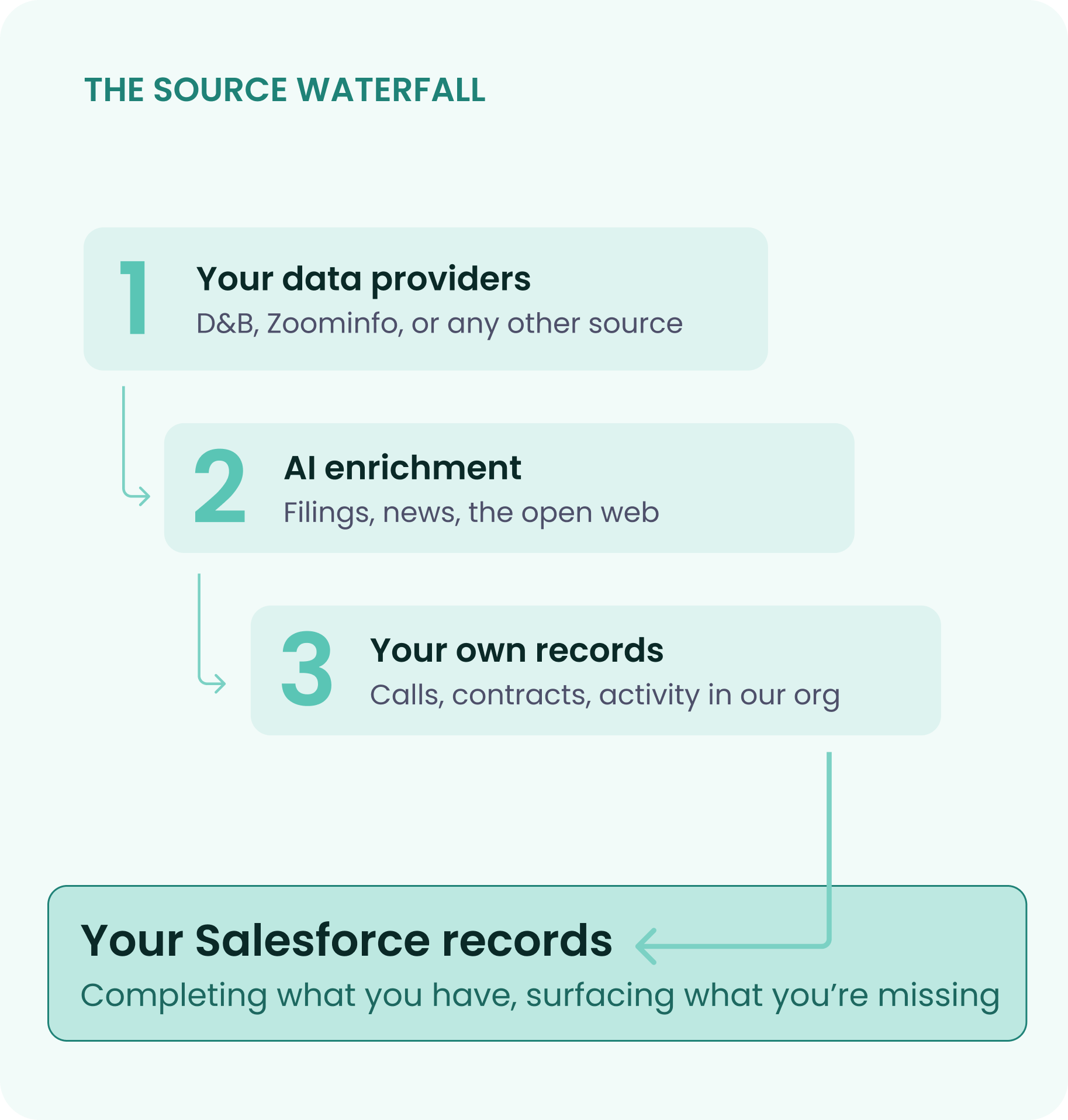
Most tools force you to pick a side: keep your data providers or go AI only. We don’t. Run the waterfall with your existing providers, or let the agents source everything themselves.
Keep what’s working
Your D&B or ZoomInfo contracts stay useful: agents pull from them first and fill only what they miss.
Tap sources no provider sells
What’s already sitting in your org, plus public filings and the open web.
Change the mix any time
Trust is set per source: you pick the order, and swap it as contracts and priorities shift.
Trust it because you can check it.
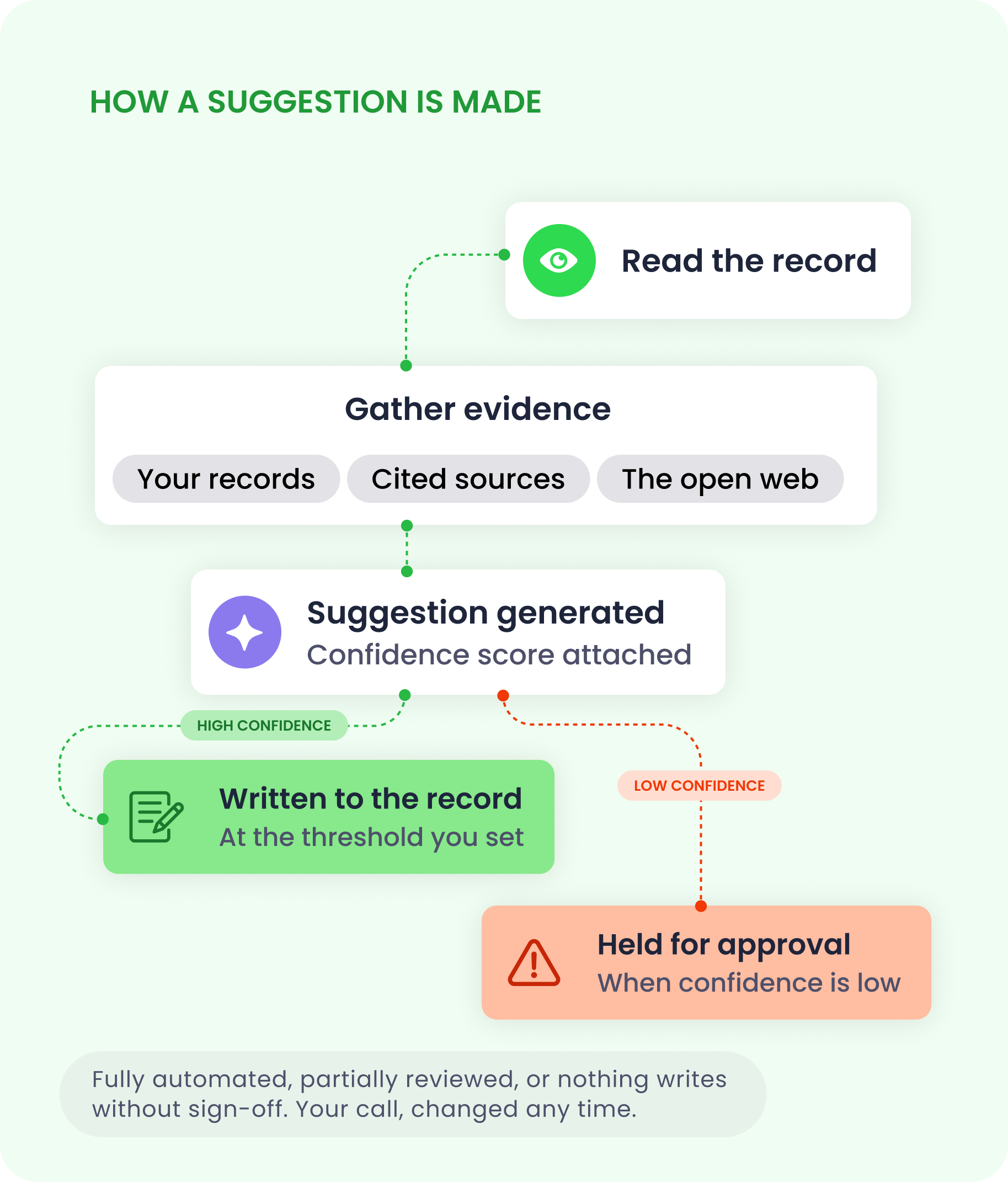
Data Agents are built to earn trust over time. They provide confidence scores, reasoning, source citations, and a human approval gate, so any answer can be verified in seconds. Start with every change reviewed, then let the agents take on more as the results prove out.
Every answer is verifiable
Suggestions cite their sources. Customers run this across hundreds of thousands of records and can verify any answer in seconds.
You set the threshold
Fully automated, partially reviewed, or nothing writes without your sign-off. Change the setting as trust builds.
It follows your rules
Suggestions come from the sources you choose, following the guardrails and definitions you set.
Data Agents at work.
A global software company applied a custom taxonomy so sales could target by product fit, not just sector.
A social platform sorts fraud and junk pouring in from web forms before reps waste time on them.
Post-acquisition naming chaos standardized and resolved to unique entities so matching and reporting worked.
A higher ed vendor kept lookalike department accounts distinct and backfilled thousands of missing IDs.
Detection surfaces acquisitions and restructures in real time, not months after the fact.
Parent-child relationships for private companies, international entities, and complex structures.