


The Account Hierarchy Data Model

Rethinking Account Data for Strategic Growth

Your CRM already holds your next revenue opportunities and risk signals, split across subsidiaries and duplicate accounts. An account hierarchy data model brings both back to the whole customer, from parent company to brand, so your teams and AI agents act faster and at lower cost.

Account Hierarchies Data Model
Introduction

More data won't build the next billion-dollar company. Better-connected data will.

Everyone has access to more data and AI.
But staying competitive keeps getting harder, because off-the-shelf inputs give everyone identical outputs. Differentiation has to come from your own customer data.

When customer accounts, subsidiaries, and buying relationships aren't connected, revenue opportunities go unseen and AI agents work with incomplete context.

Your unique data, once connected, is the edge competitors can't buy.

Introduction · Why it matters

The next-gen of operators will be the ones who rethink GTM data, not just fix it.

More data is not structured data

  • Hierarchy data isn't linked data.Subsidiaries, brands, and duplicates live in your CRM as separate accounts.
  • Agents need accounts linked.You could know that Old Spice and Gillette are one customer. Agents only know the provider-stamped record, which misses it.
  • More data? Better AI? Your competitors can buy it too.Your advantage is the history you own, like past deals, products sold, and buying patterns.

Inaccurate GTM insights stall growth

  • Revenue gets undercounted and conflicts occur.Split across subsidiaries, top customers fall under the strategic account threshold and miss top-tier coverage.
  • Whitespace stays hidden.Subsidiaries with no account in your CRM (your whitespace) never make the account plan, and warm references in the account family go unused.
  • Risk shows up late.A usage drop at one subsidiary stays on that account's record while sibling renewals are still months out.

There's a cost to poor agent infrastructure

  • Unlinked accounts drop out of agent research.Agentforce, Claude, and Model Context Protocol (MCP) workflows build territories and account plans from linked accounts only.
  • 61%of answers wrongWith one link in ten missing, agents reading Parent Account got 61% of answers wrong (recent benchmark)
  • Every answer costs tokens.Right or wrong, agents spend tokens piecing one customer together from separate accounts for each query.
Marc Benioff

“If you don't have your data right, you're not going to get your AI right.”

Marc BenioffChair and CEO of Salesforce
Introduction · Example

Hierarchy Data or an Account Hierarchy: Which Do You Have?

Microsoft is a good test for answering this question.

Providers know its account family (the parent company and everything it owns) well, but your reps can still end up working six of its accounts under different owners.

Provider databases list registered companies, and they can miss brands and lag an acquisition. Your own org adds quick-created accounts and duplicates on top.

With no account family record for Microsoft, you risk those accounts reporting as separate customers.

Scott Ellsworth

“We were at our wits end, trying to navigate a really complex data environment.”

Scott EllsworthVP Sales Operations at Windstream Enterprise
Customer Story
THINK ABOUT IT LIKE THISYour hierarchy data is in. Six of your accounts belong under Microsoft:MicrosoftGitHubLinkedInMojangNuanceXboxMinecraft2 recordsThin recordStale recordBrandBrandWHERE THE GAPS STARTAll six belong to Microsoft. Salesforce misses that in five places:Xbox and Minecraft are brands. The provider's database lists Microsoft and Mojang, the companiesbehind them, but not the brands. A lead from either brand doesn't match a Microsoft account androutes as new business.Nuance still shows as independent. The provider's database hasn't caught up with the 2022acquisition. Each sync writes Nuance back as independent.Mojang came in from a quick-create. The record has only a name and a website, too little forthe provider to match it with confidence.GitHub has two records. A converted lead created the second one, and the provider can returna different parent for each.LinkedIn and GitHub report as two customers. Your net revenue retention (NRR) report reads a LinkedIncontraction and a GitHub deal separately, and an AI agent answering from that report does thesame.
Introduction · The answer

An Account Hierarchy Data Model Turns Hierarchy Data Into One Customer Record

Your provider's hierarchy data can give Microsoft's registered companies a parent. Keeping every Microsoft account together as one customer takes an account hierarchy data model, which groups each account family under one record that your reports, routing, and AI agents read.

Hierarchy data

Your provider matches each account against its database and sends back a suggested parent. Salesforce stamps the record with that parent, right or wrong.

  • ×Thin records come back without a parent. Mojang came in from a quick-create, with just a name and a website.
  • ×The provider's database can lag an acquisition. Nuance joined Microsoft in 2022, and a database that hasn't refreshed since still lists it as independent.
  • ×Brands sit outside the database. The provider's database lists Microsoft and Mojang but not Xbox or Minecraft, the brands they own.
  • ×A converted lead can create a duplicate. GitHub has two account records, and the second one came back from the provider with no parent.
  • ×Your tools count each account as a separate customer. Reports, routing, and AI agents have no account family record to read.
HIERARCHY DATAACCOUNT HIERARCHY DATA MODELRecord as isProvider match?Written as isNo family recordGitHubParentMicrosoftGitHubParentNoneDuplicateLinkedInParentMicrosoftParentNoneXboxParentNoneBrandParentNoneThin recordMinecraftParentNoneBrandStale recordMicrosoft bought it in 2022ReportsNuance outside MicrosoftRoutingXbox lead as new businessAI AgentsMinecraft as its own customerRead each account on its ownRecord fixedParent checkedLinkedMicrosoft family recordGitHubParentMicrosoftMergedParentMicrosoftXboxParentMicrosoftBrandParentMicrosoftLinkedInParentMicrosoftMinecraftParentBrandReportsNuance in Microsoft’s totalRoutingXbox lead to family ownerAI AgentsMinecraft under MicrosoftRead the family record as one customer
Account hierarchy data model

You keep the provider data you paid for. The model then adds the links the provider match missed, like brands, late acquisitions, and duplicates. The whole account family gets one record in Salesforce.

  • Thin records get filled before the provider match. Mojang comes back with firmographics and microsoft.com as its parent domain.
  • Your fixes survive the next sync. Once you move Nuance under Microsoft, syncs managed by Complete Hierarchies skip that account.
  • Brands join the family. Xbox links to Microsoft, with Minecraft one level down under Mojang.
  • Duplicates merge into one record. The two GitHub accounts become one, and their contacts and opportunities move to the surviving record under Microsoft.
  • Reports, routing, and AI agents see one customer. All three read Microsoft's members, owner, and totals from the family record.
Introduction · Your stack

Where Your Provider, Dedupe, Hierarchy, and Routing Tools Each Stop

On paper, your stack may already cover each of the four stages: enrich, clean, connect, and orchestrate. A data provider, a dedupe tool, a hierarchy platform, and a routing engine each do their own part well.

Look closer, and each tool stops at the edge of its own step. Brands, old parents, and duplicates fall in between, and the next tool treats them as finished.

Provider databases usually stop at the registered company.
Brands can sit outside the database, and an old parent comes back with each sync.
Dedupe tools compare one record against another and miss the account family around them.
A subsidiary that shares its parent's name and domain can look like a duplicate.
Hierarchy platforms take a provider's parent as is.
When a parent comes in wrong, the branch below it joins the wrong family.
Routing engines trust the link as stored.
A lead from a brand routes as new business, and one under an old parent reaches the old owner.
1ENRICHThin records come back with thewrong parent, or none.3CONNECTHierarchy platforms link to awrong provider parent as is.2CLEANDedupe tools can’t tell an unlinkedsubsidiary from a duplicate.4ORCHESTRATERouting engines follow a staleparent link.
Introduction · The method

How to Build Your Account Hierarchy Data Model

1
Enrich from sources beyond the provider database.
  • Point AI agents at filings, press releases, and company sites to find who owns each account.
  • Check each finding against your own account names, domains, and contacts.
  • Set a confidence bar, apply the suggestions that clear it, and review the others.
2
Clean out duplicates without removing subsidiaries.
  • Score each record in a duplicate set, with the reasoning beside the score.
  • Pull subsidiaries out of the set before a merge.
  • Approve the merge, and keep the record with the parent link and the active contract.
3
Connect each member to the one at the top.
  • Roll ARR, pipeline, renewals, and usage up to fields on the family record.
  • Flag strategic accounts with one formula on the family total.
  • Give Finance, Sales, and Legal their own view of the family.
  • Count the units with no account yet as whitespace.
4
Orchestrate routing, reassignment, and agents off the data model.
  • Check each lead for a recent acquisition before assigning it.
  • Move a territory's accounts, contacts, opportunities, and leads with one owner change.
  • Flag a subsidiary's usage drop before its siblings renew.
  • Give AI agents one stored field to read for each total.
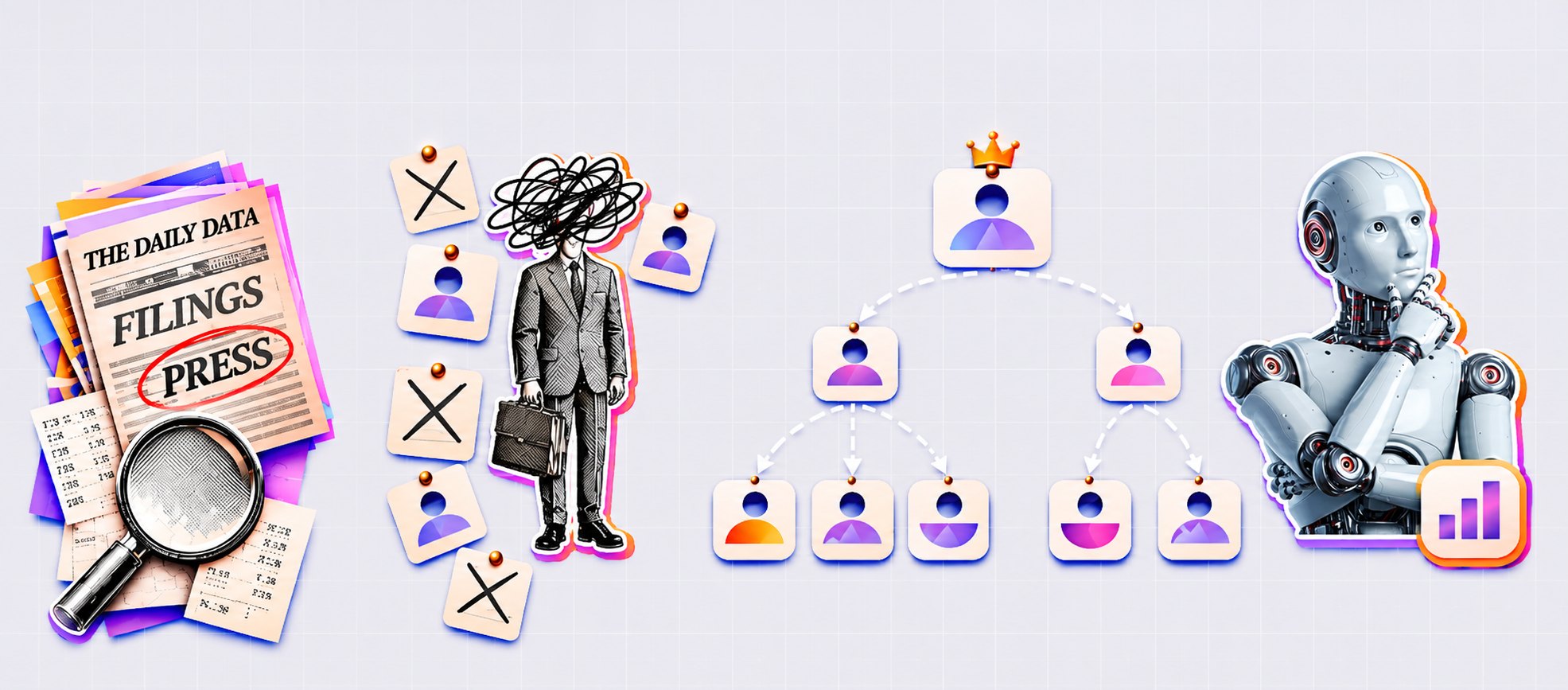
Enrich, clean, connect, orchestrate: a newspaper of filings and press under a magnifier, a confused rep among crossed-out account cards, a connected account hierarchy under a crowned parent, and an AI agent reading a chart
Inside the full guide

Table of contents

Introduction
  • 02More Data Won't Build the Next Billion-Dollar Company
  • 03The Next-Gen of Operators Will Rethink GTM Data
  • 04Hierarchy Data or an Account Hierarchy: Which Do You Have?
  • 05An Account Hierarchy Data Model Turns Hierarchy Data Into One Customer Record
  • 06Where Your Provider, Dedupe, Hierarchy, and Routing Tools Each Stop
  • 07How to Build Your Account Hierarchy Data Model
Chapter 1
Enrich
  • 09The Brands and Operating Units Missing From Your Account Families
  • 10Find the Brands and Subsidiaries Your Providers Miss
  • 11Linking Unparented Accounts to Their Account Family
  • 12When a Name and a Domain Aren't Enough
  • 13Turning a Name and a Domain Into a Routable Account
Chapter 2
Clean
  • 15Duplicate? Or Subsidiary in Disguise?
  • 16Merging Duplicates Without Merging the Account Family
Chapter 3
Connect
  • 18What the Parent Account Field Leaves Out About the Customer
  • 19Meet the Complete Company Record
  • 20Grouping Rules, Roll-Ups, and One Owner per Account Family
  • 21Flag Strategic Accounts From the Family Total
  • 22How to Give Finance, Sales, and Legal Their Own Tree
  • 23What Changes an Account Family Without Telling Salesforce
  • 24The Next Sync Reverts Your Parent Account Fixes
  • 25Stop Provider Syncs From Overwriting Your Fixes
Chapter 4
Orchestrate
  • 27Getting Reports and Routing to Read the Whole Account Family
  • 28Routing a Subsidiary's Lead to the Account Family Owner
  • 29Trigger-Based Routing With the Acquisition Check
  • 30Mass Territory Reassignment With One Owner Change
  • 31ARR, Pipeline, and Usage for the Whole Account Family
  • 32Identify Which Products Each Strategic Account Is Buying
  • 33Rolling Up Product Pipeline Across the Account Family
  • 34Fewer Tokens, Faster Answers for Your AI Agents
  • 35How We Ran the Benchmark
  • 36One Missing Link in Ten Broke 61% of Parent Account Answers
  • 373.5× Cheaper and 1.6× Faster per Answer
  • 38Building Your Strategy on the Account Hierarchy Data Model
Next steps
  • 39The Account Hierarchy Data Model Checklist
  • 40Agentic Data Management for RevOps, All in One Suite
  • 41Ready to Rebuild Trust in Your Data Layer?
The Account Hierarchy Data Model

Get the Full Guide

Turn the hierarchy data you already have into one Salesforce record per customer. The full guide shows you how to:

  • Find the brands and subsidiaries your data provider misses
  • Merge duplicates without breaking up customer families
  • Give every family one owner, one record and one revenue total
  • Route leads, roll up pipeline and report on the whole family
form image