

Across conversations with RevOps leaders, a consistent theme emerges: the challenges teams are facing today are about complexity.
Fragmented systems. Disconnected data. AI tools that promise efficiency but struggle to deliver trustworthy outcomes.
At the same time, the pressure on RevOps teams has only increased.
Customer retention and expansion are now primary growth levers. AI acceleration is accelerating – often faster than governance or data foundations can keep up. And the demand is on teams to drive revenue impact with fewer resources than ever before.
Clean data is no longer enough. In 2026, the teams pulling ahead are the ones investing in context, coordination, and orchestration across their revenue engine.
That perspective is reinforced by what we’re hearing directly from RevOps leaders in the field – including Rosalyn Santa Elena, VP of GTM Operations at SingleStore – who shares firsthand how these trends are defining how RevOPs teams operate and succeed.
Here are five RevOps trends defining 2026 – why they matter, and the practical strategies teams are using to operationalize them.
5 Biggest RevOps Trends in 2026
1. Customer retention and expansion: RevOps as a strategic player
The current go-to-market environment continues to challenge B2B companies. Acquisition costs remain high, buying cycles are longer, and budgets are under pressure.
As a result, growth strategies are shifting decisively towards retention and expansion.
Businesses have just a 5% to 20% chance of selling to new prospects, making it more difficult and expensive to acquire new customers. However, the chance of selling to existing customers is between 60% to 70%.
“We all know that expanding an existing customer is much easier and cost-effective than acquiring a net-new logo.
– Rosalyn Santa Elena
But we still spend most of our time and energy focusing on the top of the funnel, driving and building new pipeline, and shepherding deals through the funnel.”
These are the strategies that businesses are using to scale without sacrificing margins and economic health:
- Ensure the CRM captures and displays whitespace for existing customers. Key data points include what products have been purchased, complimentary products, use cases that are being addressed, customer firmographics and technographics, and organizational structure.
The goal is to identify additional capacity opportunities, additional use cases, or additional business units to expand into. - Leverage usage data to improve the customer experience. This empowers sales and customer success teams to understand how customers actually engage, tailor outreach, and deliver more relevant experiences throughout the lifecycle.
- Provide early indicators of churn risk. Rosalyn’s top factors to consider are: reduced usage; missed meetings, training, or business reviews; loss of a champion or power user; late onboarding; delayed implementation, partial, or incomplete rollout; no interest in upgrading or leverage new features. Then, use roll-up reporting to keep an eye on declining trends.
- Drive expansion through whitespace and account hierarchies. Repeat customers spend 67% more than new ones.
By leveraging account hierarchies and whitespace, GTM teams can identify additional subsidiaries, locations, and product lines where expansion makes sense – and avoid misaligned outreach where it doesn’t.
RevOps is no longer just reacting to churn or expansion requests. They’re proactively orchestrating growth across the entire account.
Pro Tip: Account Hierarchy Data in Salesforce is the Foundation for Improving your Customer Retention and Expansion.
Without optimized, connected account hierarchy data, you’ll see a downstream effect that hinders your GTM teams, how your sales reps sell across new and existing customers, and how you deliver the customer experience.
Reducing churn while still driving revenue starts with data, as well as understanding your largest customers so that you can retain and expand effectively as a business.
In addition to being able to roll-up data such as total activities and open opps, account hierarchies can also populate useful customer success metrics such as open cases and number of logins.
ACCESS: How to Improve Net Retention & Expansion
2. RevOps as the owner of AI readiness and governance
AI adoption is moving faster than data readiness, governance, and accountability. That’s created a new challenge for RevOps and a new area of ownership.
It’s also splitting the role. Owning AI governance and system design is increasingly the work of a Revenue Architect.
“When you think about AI, you think about data, technology, insights, and actionability. RevOps touches, governs, and owns all of these areas to help enable revenue growth and retention within the organization.
RevOps professionals are, by nature, experimental and are accustomed to working with new technology, new solutions, and new methodology and approaches, so working with AI is a natural fit.”
Here’s how RevOps teams are operationalizing AI readiness:
- Prepare data before deploying AI workflows. AI amplifies whatever data it’s given; good or bad. So if you want useful insights, put data readiness for AI on the project plan ahead of the tool choice.
- Design human-in-the-loop processes. Instead of starting with full autonomy, high-performing teams keep humans involved until accuracy thresholds are consistently met.
That means ensuring a human reviews, edits, and approves AI outputs – specifically when they impact customers, pipeline, or revenue. - Centralize AI experimentation and governance. Rather than allowing AI tools to sprawl, standardize pilots, define success criteria upfront, and require post-pilot interviews to determine whether tools should be scaled or retired.
- Measure trust and accuracy, not just adoption. Beyond usage metrics, RevOps leaders are tracking override rates, correction frequency, and confidence in AI recommendations. When trust erodes, adoption quickly follows – meaning accuracy is a core KPI.
- Build your business use case for AI. Before investing in any AI-powered platform, RevOps teams need a framework that answers the questions their executive team – and their future selves will be asking.
Check off all the boxes before buying an AI tool and build a business case to get buy-in from leadership.
Preparing data ahead of AI is a standing job, not a pre-launch scramble. Agents run the dedupe and normalization continuously, which keeps the data ready whenever the next workflow ships.
3. Context as the unlock for AI and expansion
One of the most common frustrations we hear from RevOps leaders is this: they have plenty of data, but their systems still get decisions wrong.
Leadership discussions from AI Unfiltered surface this issue repeatedly. The problem isn’t the volume of data. It’s a lack of context.
And that context is what explains how data should be interpreted inside a specific business.
Here are four ways that RevOps teams can build actionable context:
- Invest in account hierarchies and ownership logic. Create context by building account relationships, parent-child structures, and ownership rules in Salesforce.
Not only does this context improve routing, forecasting, and expansion, it ensures that AI-driven insights are credible. - Respect regional, segment, and product differences. RevOps leaders are reducing errors by ensuring systems account for GTM differences across regions, segments, and product lines – instead of applying one-size-fits-all logic.
- Capture qualitative signals alongside quantitative data. Context includes understanding why deals were won or lost, why customers expanded, and what drove churn. By capturing these insights, RevOps teams can make better data-driven decisions and plan for the future.
- Constrain AI to trusted context when accuracy matters. When it comes to high-impact workflows, limit AI to retrieval-based insights that are grounded in trusted data sources. This reduces data hallucinations and reinforces trust.
4. Investing in data management and seamless orchestration
As go-to-market strategies become more complex, RevOps teams are facing a familiar challenge: manual data management doesn’t scale.
RevOps leaders consistently point out that one-off fixes, spreadsheets, and reactive cleanup slow teams down and creates additional risk.
On top of that, teams struggle to make sense of data as it moves across different platforms and proliferates. As a result, teams may think it, they don’t have quality data to make the important decisions that drive their business forward.
Here are different strategies to move towards actionable, connected data:
- Standardize data entry and validation. Inconsistencies around data collection and entry can lead to data quality issues and reporting challenges. Address this by introducing standardized procedures and formatting data entry, such as standard forms, validation rules to prevent errors at point of entry, and training for staff.
- Implement data governance standards. Establish specific, measurable metrics for data quality and communicate those standards across the wider team. These metrics can include accuracy, completeness, consistency, timeliness, and uniqueness.
- Establish routine data audits. It’s not uncommon for RevOps teams to use multiple data providers. Planned, routine data audits prevent data discrepancies from arising from different tools and providers, data not being standardized, and flowing incorrectly between systems.
Additionally, one of the biggest areas where Rosalyn sees data quality suffer is when business strategies or process change, but those changes aren’t accounted for, updated, or maintained within the systems where data is entered, modified, or used.
Salesforce data stewardship closes that gap by giving each field a named owner who approves changes as the process moves. Remember, the goal isn’t perfect data. - Automate matching between related records. Leads and accounts aren’t automatically matched in Salesforce. Connect leads, accounts, opportunities, and contacts to create a unified customer view, prevent duplicates, and improve routing and reporting accuracy.
Remember, the goal isn’t perfect data. It’s data that remains reliable as the business scales.

What Orchestration Looks Like in Practice
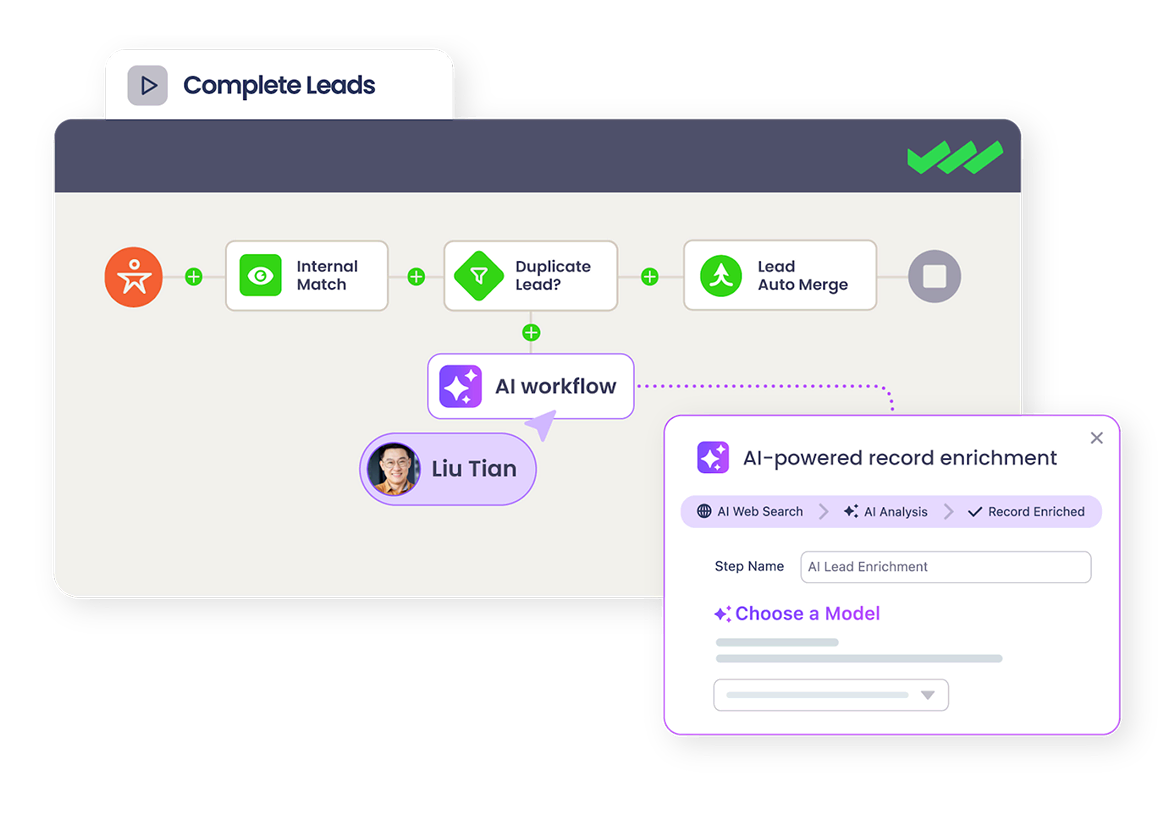
In the age of AI, the useful definition is narrower: routing that adapts to real-time signals, reads AI-enriched data, and improves with every engagement cycle.
Our guide on Lead Routing in the Age of AI, covers five tactical plays that build toward it, with flow diagrams and customer patterns from teams already running them.
5. Shiny AI and tool sprawl
The final trend that RevOps leaders are increasingly cautious of is shiny AI and tool sprawl.
While the different pieces of your tool stack may work well in isolation, together they often create conflicting insights and erode trust.
“The dreaded Frankenstack. We’ve all been there and have had to deal with tool sprawl. But with each new tool comes not only dollars for software cost, but costs associated with implementation, configuration, enablement and training, ongoing maintenance, and day-to-day administration.
The other cost is keeping this new tool in sync, integrated, and aligned with every other tool in your tech stack.”
Here’s how RevOps teams we’re talking to are addressing AI sprawl:
- Build a tech stack around fewer tools and shared context. Instead of adding more AI, RevOps leaders are consolidating around fewer systems that operate on the same data, definitions, and logic.
Similarly, acquire tools that fulfill multiple use cases and meet several of your business requirements at once. A platform approach versus point solutions will help reduce the size of your tech stack.
Scheduling is a common point solution to fold in. Meeting scheduling software like Complete Schedule puts routing, matching, and booking on one Salesforce-native platform, one fewer tool to sync, license, and administer. - Limit overlapping recommendations. When multiple tools surface different “next best actions,” trust quickly drops. Carefully control where AI recommendations appear and ensure consistency across systems.
- Sequence AI adoption rather than stacking tools. Introduce AI incrementally, validating accuracy and impact before expanding to new cases.
- Perform an end-to-end tech audit: This allows teams to identify redundancies in functionality, tools you’re no longer using, functionality and features that you may not be leveraging, and potential consolidation.
Ensure that your Salesforce data is clean, connected, and orchestrated in 2026
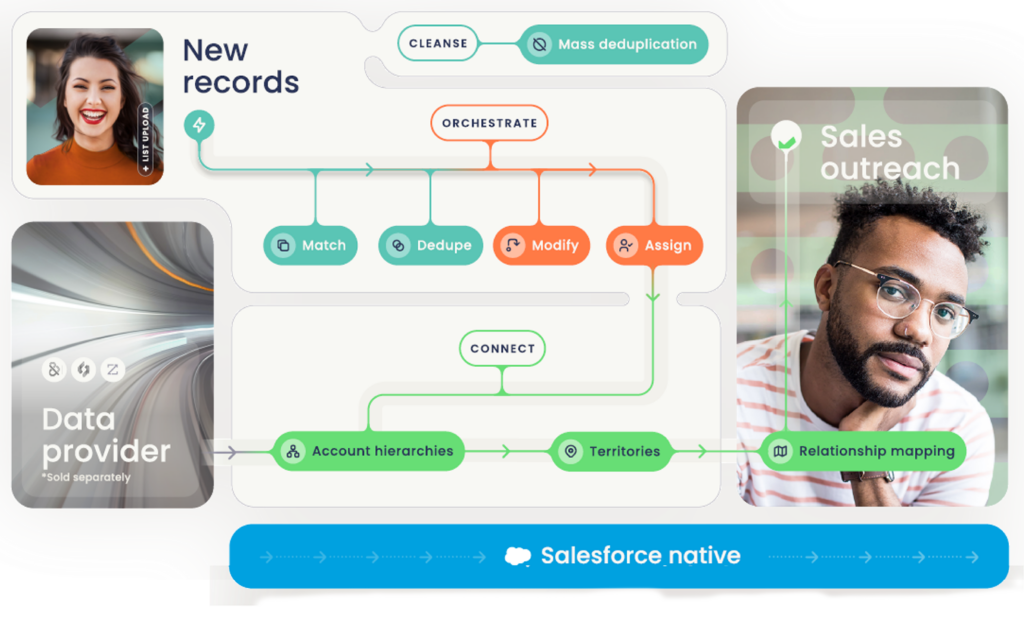
Succeeding in RevOps in 2026 isn’t about adopting more tools – it’s about building better systems.
Retention and expansion depend on connected customer signals. AI only delivers value when it’s grounded in trusted data and clear governance.
Context determines whether insights are actionable or misleading. And orchestration is what allows RevOps teams to scale without constant manual intervention.
Success in RevOps this year won’t come from chasing shiny AI or adding more point solutions. It will come from investing in foundations — the data, processes, and guardrails that make every GTM motion more reliable.
Ultimately, RevOps isn’t just supporting growth anymore.
It’s designing the systems that make growth repeatable.
Want to see how we’re helping other RevOps teams transform their processes and get the full picture around their data? Read our customer stories to learn how we’re helping leading companies like Zoom, Asana, and Cisco do more in Salesforce.